Whiteacre Linen started at half past five, when the rest of Wetherfold was still dark and the only lights on the industrial estate belonged to the laundry and the bakery across the road.
Kit liked it, mostly. He liked the heat, which hit you at the door like opening an oven: forty tumble dryers the size of garden sheds, all running at once, and the smell of hot cotton and bleach and the soap they bought in drums. He liked the women on the folding line, who had called him Striker since his first week and never once meant it kindly. He liked the cages of pressed white sheets waiting in the loading bay like blocks of fresh snow, ready to go to hotels where people would sleep in them without ever wondering where they'd been.
This morning the folding line applauded when he walked in.
"Here he is," said Shirley, who ran it, and who was sixty-four with forearms like a blacksmith's. "Ninety-fifth minute. Did it hurt, love? Your face on the video looked like it hurt."
"Only when I'm awake," said Kit.
Craig was at the loading bay with his clipboard. He'd been cool with Kit since the text on Tuesday: polite, professional, the way you're polite to a man who has turned down your daughter. He handed over the delivery sheets without a word. Then, as Kit climbed into the cab, he said, "Saw the goal."
"Yeah?"
"My lad's made it his screensaver." Craig looked at his clipboard. "Leeds run, then Harrogate. Harrogate's the big one, they've got a wedding. Don't be late."
◆ ◆ ◆
The first one came at a set of lights on the ring road, at ten past six.
A grey car pulled away from the junction while the light was still red. Kit watched it go, bracing for the crunch, until the light turned green and a real car, the same shape and colour, pulled away along exactly the same line, five seconds behind its own ghost.
The second came on the A-road out of Leeds, just after seven. A grey cyclist swung out from behind a parked bus without looking. Kit braked hard, and the van behind him blared its horn. Five seconds later, the real cyclist swung out from behind the bus, without looking, into the space where Kit's van would have been, and pedalled off into the morning without ever knowing.
Kit pulled into the next lay-by, switched off the engine, and sat with both hands on the wheel until they stopped shaking.
It wasn't constant. That was almost the worst part. For long stretches the world was single and solid, white lines unspooling under the headlights, the radio murmuring about roadworks. Then, for a second or two, it would slip: a grey woman stepping off a kerb ahead of her real self, a grey pigeon lifting off a lamp post the real pigeon hadn't left yet. Then it would snap back, like a telly that had lost the signal and found it again.
There was no board. No window, no green dots, no summary at the end. The future was simply leaking, in little grey drips, into a Monday morning where it had no business being.
He thought about Saturday. Four decisive actions. Five point three seconds. Three towels.
He drove the rest of the way to Harrogate at forty miles an hour in the inside lane, like a learner.
◆ ◆ ◆
The draw for the fourth qualifying round of the FA Cup was at lunchtime, streamed live from an office somewhere in London. Kit watched it on his phone in the service yard of the Harrogate hotel, sitting on the back step of the van with a sausage roll going cold on his knee.
It was the least glamorous thing he had ever seen. Two men in suits took numbered balls out of a velvet bag and read out team names in the voices of people announcing a delayed train. Dozens of clubs Kit had never heard of were drawn against dozens more, while the comments underneath scrolled past, full of fans from small towns typing in capitals.
"Number twenty-seven," said one of the men. "Wetherfold Town."
Kit sat up.
"Will play number thirty-one." A ball rolled. The man squinted at it. "Cleckfield Athletic."
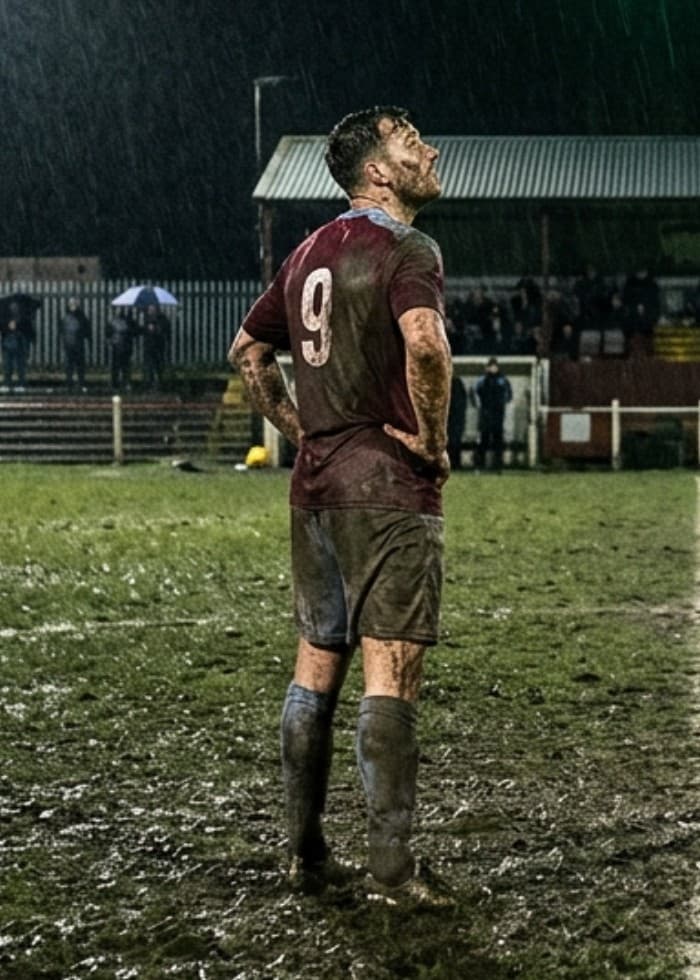
The comments exploded. Kit didn't read them. He sat on the step with the sausage roll in his hand and thought about the road over the tops that shut whenever it snowed, and a free Saturday every other week, and Mags's mouth going thin as she said ground-share at Cleckfield Athletic.
The club that wanted to be their landlord. Coming to the Pinfold. With everything riding on it.
His phone buzzed. Aled.
THE LANDLORDS!!! AT HOME!!! I'm going to kick their chairman in the shins!!
A minute later: I won't actually do that. Unless you think I should.
◆ ◆ ◆
Norman did the big wash on Monday evenings. Kit found him in the kit room just after six, feeding maroon shirts into the enamel monster one at a time, as carefully as if he were posting letters.
Kit told him all of it: the lights on the ring road, the cyclist, the lorry on the M1. He'd meant to sound calm. He found that he couldn't, quite.
Norman didn't interrupt. When Kit had finished, he shut the machine door, turned the big dial to a setting marked with a strip of masking tape that said COLOURS – NOT HOT, and pressed the button. The machine thought about it, then began to turn.
"Spring of seventy-two," Norman said, still facing it. "That's when it started for me. We'd just gone up the second time. I was using it every game. Every second it would give me. Didn't matter if we were four up. If the board was there, I was looking." He was quiet for a moment. "Greedy, I was. I'd been nobody for twenty-two years, and then I was Late Norrie, and I liked it."
"And then it started leaking."
"In the pub first. Then crossing the road. Then all the time. I'd be sat having my tea and I'd see my mother put the teapot down five seconds before she did." He turned round. His face was very still. "You try living five seconds ahead of everybody. You never catch up with yourself. You stop sleeping. My nose used to bleed on the pillow. My mother thought I was taking something."
"What did you do?"
"Ravensmoor City came in for me," said Norman. "And I went."
Kit stared at him. "You went to get away from it."
"I went for forty quid a week and a Ford Cortina," said Norman. "And to get away from it. Both. You can want two things at once." He lowered himself into the chair. "First game at City, no board. A week after that, no leaking. I've not seen a grey thing since. Not once in fifty-four years." He looked down at his hands. "So I don't know, son. I've never known. Whether I lost it, or it let me go."
"Or whether you ran," said Kit, and wished he hadn't.
Norman didn't flinch.
"Aye," he said. "Or that."
The machine sloshed and hummed. Out in the car park, a car door slammed.
"What do I do?" said Kit.
"Use it when it matters. Not every time it's there." Norman held his eye. "It's not a tap you leave running. I'd have told you that on Sunday if I'd known it would come on this quick. Mine took two years to start leaking. Yours has taken two games."
The door opened before Kit could answer.
Mags Culley came in with her coat on, her handbag over her arm, and her scarf, as always, round her neck. Behind her, holding an open laptop against her chest like a tray, was Nadia Farooq.
"Good. You're both here," said Mags. "Norman, you'll want to see this. Kit, you'd better."
"Is it the draw?" said Kit.
"It's the man who rang me an hour after it." Mags nodded to Nadia. "Go on, love."
Nadia turned the laptop round. On the screen was a company website, all glass offices and smiling families on new lawns: KESTREL RIDGE HOMES – BUILDING THE NORTH'S FUTURE. Beneath it was a page headed Our Leadership Team, with a row of photographs of men in open-necked shirts.
Nadia pointed to the third. Sixty-odd, tanned, silver-haired, with the easy smile of someone who had never had to queue for anything.
"Gareth Lomas," she said. "Regional Land Director." She clicked to another tab: Cleckfield Athletic's website, with a photo of a brand-new stand whose roof said KESTREL RIDGE HOMES in letters you could read from the bypass. The same smile looked out from beside the club crest. "And chairman of Cleckfield Athletic."
Nobody spoke. The washing machine went into its rinse cycle with a noise like a long sigh.
"I've known Gareth Lomas thirty years," said Mags. "He used to be a decent left-back. I knew he'd done well for himself. I didn't know how well, or for whom." She pulled her scarf a little tighter. "If he gets our ground, his company builds sixty-four houses on it, and his football club gets ours as a tenant, paying him rent, twenty-two miles from home."
"And now we've got to beat him," said Kit. "For the ground."
"He said as much. Very nicely. 'May the best club win, Margaret.'" Her mouth went thin. "Then he made me an offer. Not for the Pinfold. For you."
Kit blinked. "Me?"
"Two thousand pounds for your registration. And a job at Kestrel Ridge Homes. Trainee site manager, thirty-one thousand a year, van provided, weekends off." She said it flatly, like a shopping list. "You're on non-contract terms, like all the lads. If you sign his form, I can't stop you. The two thousand is so I'll be gracious about it."
"But I'm cup-tied," said Kit. "I've played in the Cup for us. I couldn't play against us for him."
"No, love," said Mags. "He knows that. He doesn't want you in his team." She looked at him steadily. "He wants you out of ours."
Kit looked at Norman.
Norman was looking at the washing machine, at the maroon shirts turning over and over behind the glass, and his face gave nothing away. But Kit knew what he was thinking, because he was thinking it too.
Sign the form, change the shirt, and in a week there would be no more board.
And no more grey lorries on the M1.
Comments (0)